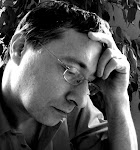
I'm just back from a giving workshop on creative writing for a group of adult learners. These were mostly people who have difficulty with reading and writing. A good proportion of them were dyslexic. (Presumably that is why I was invited to give the class - because of my own dyslexia.)
I could certainly relate to the anxiety of some of the students on being given a form to fill in at the beginning of the session. Also the fact that the class was in a different room and at a different time from their normal workshops.
And then a third anxiety - I was going to make them write, wasn't I? That was the first thing I had to make clear. I don't get students to do much writing - even when they want to! I certainly wasn't going to ask this group to put pen to paper. My workshops are more concerned with imagining and understanding. We imagine scenes. We understand how stories work. We think ourselves into different places and times.
Today we used photographs of real people as a basis for creating imaginary characters. Then we used keys and mystery packages to help us imagine places. And we made up stories.
I was also told some true stories by one person - which were certainly more amazing and horrifying than anything I could have made up. Quite frankly, I am still stunned by them. And astounded by the fortitude of the person who told me.
Wednesday, May 13, 2009
What use a bag of old keys?
What use indeed.
Keys are interesting objects. They are vital to us when the lock they open is still in use but become junk as soon as the locks are changed. Somehow I could never bring myself to throw them out. Thus I have accumulated a jangling bag full of the things.
They are tactile objects. Put a hand in the bag and feel the rough and smooth edges. They make sound when they rub against each other. And they have that distinctive smell carried by old metal objects. A smell of subtle corrosion, I suppose.
Today the keys are getting an outing. In an hour I will be taking them into town to a writing workshop for adult dyslexics. We are going to be constructing stories together and the keys are going to help. A key is a good starting point for many a story. And I am happy to say, we won't be writing any of the stories down. This will be story craft done in the old way.
Keys are interesting objects. They are vital to us when the lock they open is still in use but become junk as soon as the locks are changed. Somehow I could never bring myself to throw them out. Thus I have accumulated a jangling bag full of the things.
They are tactile objects. Put a hand in the bag and feel the rough and smooth edges. They make sound when they rub against each other. And they have that distinctive smell carried by old metal objects. A smell of subtle corrosion, I suppose.
Today the keys are getting an outing. In an hour I will be taking them into town to a writing workshop for adult dyslexics. We are going to be constructing stories together and the keys are going to help. A key is a good starting point for many a story. And I am happy to say, we won't be writing any of the stories down. This will be story craft done in the old way.
Tuesday, May 12, 2009
Telling a story through Editing
Novelists are solo story tellers (usually). Screenwriters are one of a team. If you have ever doubted the role of the movie editor in telling a story, then this amazing video may change that:
I can't even begin to imagine how much work this must have taken to produce. It is an editing miracle. Starting with nothing coherent, the editor has created a gem. Consider then, what an editor can do with a well crafted story, beautifully filmed, acted and directed.
Magic.
I can't even begin to imagine how much work this must have taken to produce. It is an editing miracle. Starting with nothing coherent, the editor has created a gem. Consider then, what an editor can do with a well crafted story, beautifully filmed, acted and directed.
Magic.
Best Blogs on writing
There is some great stuff on writing out there in the blogosphere - though you may need to dig a little to find it.
I came across this fascinating article on education and the teaching of literature. The author, Gisela Hoyle, is not only a teacher, but also a hugely talented novelist and poet. Gisela asks if children can be educated properly through anthologies, or do they need to be exposed to whole books? Are we living in a pot-noodle culture?
And here is another fine article from Emma Darwin. Ugly ducklings and ducks. How we emerge as writers - or artists of any kind - through a process of development. I am ashamed to say, I haven't read any of Emma's books. But if her blog is anything to go by, they will be superb.
Finally, here is another thought-provoking article from Nicola Monaghan. She talks about realism in film and the difference between British and American approaches to realism.
If you know of other exceptional articles on writing out there in the blogosphere, please do let me know.

I came across this fascinating article on education and the teaching of literature. The author, Gisela Hoyle, is not only a teacher, but also a hugely talented novelist and poet. Gisela asks if children can be educated properly through anthologies, or do they need to be exposed to whole books? Are we living in a pot-noodle culture?
And here is another fine article from Emma Darwin. Ugly ducklings and ducks. How we emerge as writers - or artists of any kind - through a process of development. I am ashamed to say, I haven't read any of Emma's books. But if her blog is anything to go by, they will be superb.
Finally, here is another thought-provoking article from Nicola Monaghan. She talks about realism in film and the difference between British and American approaches to realism.
If you know of other exceptional articles on writing out there in the blogosphere, please do let me know.
Monday, May 11, 2009
Five Leaves Young Adult book launch
Here are a few photographs from the Five Leaves launch of three new young adult titles. (Please see this article for the full write-up.)


 Claire Tulloch reads from her debut novel DROWNED.
 David Belbin talks about the process of getting LOVE LESSONS published and the way in which young adult fiction has always pushed the boundaries of what the publishing industry considders acceptable for that age.
 The pannel discuss gender point of view in fiction. Does the reader have a problem with the author writing from the point of view of a different gender? Does the author have a problem with it? Not acording to the pannel.
The audience gathering in the hall at the Adult Education College, Welington Street, Leicester.
Dan Tunstall talks about his young adult novel BIG AND CLEVER.
Claire Tulloch reads from her debut novel DROWNED.David Belbin talks about the process of getting LOVE LESSONS published and the way in which young adult fiction has always pushed the boundaries of what the publishing industry considders acceptable for that age.The pannel discuss gender point of view in fiction. Does the reader have a problem with the author writing from the point of view of a different gender? Does the author have a problem with it? Not acording to the pannel.Sunday, May 10, 2009
What Shape is Red?
As reported yesterday, I attended a book launch on Thursday evening. But earlier that day I'd had the chance to attend an exhibition at the Institute of Creative Technologies at DMU. The work on display had been created by students of the Creative Technologies masters programme.
I’d heard a little about the course already. I knew it was interdisciplinary, taking components of computing, writing, design etc and allowing the students a fair bit of freedom to shape the course to match their own interests. They graduate with either an MA or an MSc, depending on the bias of their work.
But that knowledge was all abstract. I had no idea what a showcase of students’ work would physically look like.
Without describing each piece in detail there is no way to sum up what I saw beyond saying it does exactly what it says on the tin. Creative technology. Here are two examples:
First Rhys Davis – whose name you may have seen in connection with the Zombie Undead film, of which he is the director. On first sight, his exhibit seemed to be a large screen on which were projected the silhouettes of flocks of flying birds. But when I stepped up to it, I found a kind of shadow of myself on the screen – in purple – under which the birds tended to congregate.
“It’s just a game, really,” Rhys confided apologetically. “A toy.” No need to apologise. I stood there watching the movement and the interaction, fascinated by the way the birds followed me as I shifted across the screen. I loved it. I could have stood there for hours, but there was a queue of other people waiting to have a go.


I’d heard a little about the course already. I knew it was interdisciplinary, taking components of computing, writing, design etc and allowing the students a fair bit of freedom to shape the course to match their own interests. They graduate with either an MA or an MSc, depending on the bias of their work.
But that knowledge was all abstract. I had no idea what a showcase of students’ work would physically look like.
Without describing each piece in detail there is no way to sum up what I saw beyond saying it does exactly what it says on the tin. Creative technology. Here are two examples:
First Rhys Davis – whose name you may have seen in connection with the Zombie Undead film, of which he is the director. On first sight, his exhibit seemed to be a large screen on which were projected the silhouettes of flocks of flying birds. But when I stepped up to it, I found a kind of shadow of myself on the screen – in purple – under which the birds tended to congregate.
“It’s just a game, really,” Rhys confided apologetically. “A toy.” No need to apologise. I stood there watching the movement and the interaction, fascinated by the way the birds followed me as I shifted across the screen. I loved it. I could have stood there for hours, but there was a queue of other people waiting to have a go.
Second, Paul Found, who had started his project by asking a synesthetic question: “What shape is red?”
Synesthesia is a hardwired crossover of senses in the brain with which a small percentage of people are born. Taste to colour, perhaps. Shape to sound. It seems to be quite individual and different for each person. My daughter has this to some degree, having colours and shapes associated with words, numbers, times, objects and people.
Paul Found, a non-synesthetic – approached the question logically, taking the three numbers of the RBG system associated with each colour and using them to construct a three dimensional graph – which he then created using a three dimensional printer. It all sounded very high-tech to me. Although in finishing his colour models he had to resort to paint spray, car polish and elbow grease.
There was no suggestion that any synesthetic would agree with his colour to shape maps – indeed it would have told us something unexpected and fascinating about the brain had they done so. But the objects he created were undoubtedly beautiful and wonderfully tactile. I showed my daughter photographs of his red model and she pulled a face. "That's just weird," she said. "That's not red. Red is 2 dimensional."
The exhibition gave the impression that a group of intelligent and talented individuals had been given a room full of high tech toys and told to play for a few months. In the present economic climate that might seem to be a strange luxury.
But I found the results of their work enjoyable and stimulating. The world would be a far poorer place without them.
Saturday, May 09, 2009
Young Adult Fiction book launch
Bali Rai, Ross Bradshaw and Maxine Linnell introduced a multi-book launch hosted by Leicester Writers’ Club last Thursday.
Dan Tunstall’s book BIG AND CLEVER and Claire Tulloch’s DROWNED were launched alongside a new edition of David Belbin’s hit novel LOVE LESSONS. The three books were recent additions to the list of Nottingham-based publisher Five Leaves.

I have a lot of time for Five Leaves, and not just because they published my novella THE MENTALIST. They are a fine example of the growing band of independent regional publishers who are giving a voice to authors who might not be picked up by the London-based giants.
Why would the big boys/girls avoid books other than because they were poorly written? They might be deemed un-commercial for a start. They might be hard to classify. They might be risky. They might be out-and-out dangerous.
Young adult fiction is not a market for the squeamish. Adults think a 15 year old should be reading Harry Potter. Safe fiction. But a 15 year old is going through the full range of adult emotions – and with an intensity that it is hard for me (on the wrong side of 40) to even remember. They need fiction that challenges them and helps them to make the huge transitions of life that they are enduring. If they don’t want ‘safe’, perhaps they should look at the growing young adult list from Five Leaves.
Dan Tunstall’s book BIG AND CLEVER and Claire Tulloch’s DROWNED were launched alongside a new edition of David Belbin’s hit novel LOVE LESSONS. The three books were recent additions to the list of Nottingham-based publisher Five Leaves.
I have a lot of time for Five Leaves, and not just because they published my novella THE MENTALIST. They are a fine example of the growing band of independent regional publishers who are giving a voice to authors who might not be picked up by the London-based giants.
Why would the big boys/girls avoid books other than because they were poorly written? They might be deemed un-commercial for a start. They might be hard to classify. They might be risky. They might be out-and-out dangerous.
Young adult fiction is not a market for the squeamish. Adults think a 15 year old should be reading Harry Potter. Safe fiction. But a 15 year old is going through the full range of adult emotions – and with an intensity that it is hard for me (on the wrong side of 40) to even remember. They need fiction that challenges them and helps them to make the huge transitions of life that they are enduring. If they don’t want ‘safe’, perhaps they should look at the growing young adult list from Five Leaves.

Claire Tulloch’s DROWNED follows a teenage boy coming to terms with the death of a close friend in rural Ireland 30 years ago. Was it an accident or was it murder? The protagonist sets out to discover the truth. Dan Tunstall’s BIG AND CLEVER addresses teenage identity and football violence. Whilst David Belbin’s LOVE LESSONS goes for the ultimate taboo – a relationship between a 15 year old girl and her teacher.
Acording to Belbin, the young adult genre has shifted over the years to accept ever more controversial subjects. It took a long time to get LOVE LESSONS accepted by a publisher. But it turned out to be a huge hit with its target audience. There is clearly a gap between what the industry is comfortable with and what young adults are hungry for.
 What about the moral implications of writing about these subjects for this audience? The question was asked by a member of the 60-strong audience, and must surely have been on the minds of many. A difficult question to answer. The authors agreed that young adult audiences should be credited with some understanding and moral judgement. They are capable of interpreting a moral ambiguity.
I was listening to this, thinking how glad I am that it is not me having to draw the line between what is acceptable and what is not. There is a huge gulf between the ghastly preachiness of overtly moralistic stories and the ethical quagmire of stories that are detached from all moral compass. Somewhere between the two must be a balance.
Not a happy balance though. It is never going to be that.
Friday, May 08, 2009
Gender, Author and Character part 2
This topic keeps coming up in conversations and e-mails since I posted a couple of days ago. I was at a book launch for three young adult novels last night. The question of gender and characterization came up in the talks, so I asked for comments from the three authors.
Claire Tuloch said she was drawn to writing descriptive passages in her novel DROWNED, and that a male point of view seemed the natural voice for her in getting the tone she was looking for.
David Belbin said he often takes a female point of view in his novels because he finds women more interesting to write about. Having said that, it is only recently that he has stepped into writing female protagonists from the first person. In the context of a supplementary question about other people's reactions, he said: Writers have the right to do anything" - which I liked.
Dan Tunstall said writing a first person female narrative was on his to-do list.
I'll write more about the launch in another post.
For another novelist's take on writing from the opposite gender, we move to an e-mail I received from thriller writer David Hood. I've blanked out some names to protect the possibly guilty:
Interesting blog on gender in writing. It has always been my view that there is a big difference between getting action right and thought right, and an even bigger difference between plot driven novels and those with lots of introspection. The deeper the book gets into the character’s head, the harder it is to get the opposite gender right, because it’s delving into something that you cannot possibly have observed. I know, for example, that two days a month some of my female charters are going to act differently, and I can do a fair job of describing the change in behaviour, but I have no idea, nor courage enough to try to describe, the change in internal thought and emotional processes that’s driving it. The more you claim to be describing the thoughts (sometimes unconscious and often suppressed) of someone of the opposite gender, the more you lead yourself towards danger.
It always surprised me that some of the great female literary writers get the subconscious workings of their male characters wrong, especially when they try to delve into suppressed sexual or ego driven instinct (XXXX XXXXX who is otherwise a brilliant author is a prime example; I remember throwing a couple of her books across the room because she got the male motivation wrong at the critical emotional point of the book. XXXX XXXXXXXX and XXXXXXX XXXXXX have suffered similarly at my frustrated hand). I have always assumed – though I’m not in a position to judge – that male authors return the compliment when delving too deeply into the subconscious of women.
Claire Tuloch said she was drawn to writing descriptive passages in her novel DROWNED, and that a male point of view seemed the natural voice for her in getting the tone she was looking for.
David Belbin said he often takes a female point of view in his novels because he finds women more interesting to write about. Having said that, it is only recently that he has stepped into writing female protagonists from the first person. In the context of a supplementary question about other people's reactions, he said: Writers have the right to do anything" - which I liked.
Dan Tunstall said writing a first person female narrative was on his to-do list.
I'll write more about the launch in another post.
For another novelist's take on writing from the opposite gender, we move to an e-mail I received from thriller writer David Hood. I've blanked out some names to protect the possibly guilty:
Interesting blog on gender in writing. It has always been my view that there is a big difference between getting action right and thought right, and an even bigger difference between plot driven novels and those with lots of introspection. The deeper the book gets into the character’s head, the harder it is to get the opposite gender right, because it’s delving into something that you cannot possibly have observed. I know, for example, that two days a month some of my female charters are going to act differently, and I can do a fair job of describing the change in behaviour, but I have no idea, nor courage enough to try to describe, the change in internal thought and emotional processes that’s driving it. The more you claim to be describing the thoughts (sometimes unconscious and often suppressed) of someone of the opposite gender, the more you lead yourself towards danger.
It always surprised me that some of the great female literary writers get the subconscious workings of their male characters wrong, especially when they try to delve into suppressed sexual or ego driven instinct (XXXX XXXXX who is otherwise a brilliant author is a prime example; I remember throwing a couple of her books across the room because she got the male motivation wrong at the critical emotional point of the book. XXXX XXXXXXXX and XXXXXXX XXXXXX have suffered similarly at my frustrated hand). I have always assumed – though I’m not in a position to judge – that male authors return the compliment when delving too deeply into the subconscious of women.

As always, comments are welcomed...
Thursday, May 07, 2009
Does Dyslexia Exist?
I came across this blog article today and felt moved to write a response. In brief, the article states that 'dyslexia does not exist'. Regular readers will know I disagree. My response to the article is below:
To begin with Graham Stringer's remarks: he seems to have based his article on the astounding assumption that if someone can be taught to read and write then they cannot be dyslexic. He added to that with literacy statistics from different countries for which I can find no basis in fact. If his article was intended as a means of self-publicity, it has certainly worked. I did pursue the Labour party about it and they confirmed that he was not reflecting party policy (their response to my questions on the issue can be found here.)

In contrast to Graham Stringer's risible article, Julian Elliott's work is coherent and based on facts. The popular presentations of his work, however, take a similarly narrow definition of the problem. The argument seems to be that once a child has been taught to read and write, the question of dyslexia has no more meaning.
This is at odds with my experience.
I have known many adults who struggled through the education system, eventually managing to learn to read and write, but in adult life always felt out of step with the world around them - sensing that other people were doing things differently but not quite being able to put their finger on what the difference was. Then at some point (typically when they re-entered education) it was pointed out to them that they were probably dyslexic.
Suddenly their many strange quirks fell into a pattern. The fact that they could not easily remember left from right or track the flow of time or retrace their steps out of a big building. Their anomalous abilities were also pointed out to them. It was a moment of huge relief for many. A psychological burden being removed. A puzzle explained.
I am quite prepared to look at arguments that say the funding structures in education are distorted by the idea of a single one-size-fits-all diagnosis of 'dyslexia'. And synthetic phonics – wonderful. If it works, let its use be expanded. (It seems to be extremely similar to the system that was used to teach me after I was diagnosed with dyslexia back in the 1970s.) But to say: because we can now teach all children to read and write 'dyslexia doesn’t exist' is to miss the point entirely.

Early medicine might have described many different illnesses with the same words - “a fever” perhaps, or a “congestion of the lungs”. It took developments in medicine before the specific causes could be identified - different varieties of flu, which can only now be defined genetically. H1N1 flu existed before it could be properly defined or diagnosed.
Dyslexia exists also.
To begin with Graham Stringer's remarks: he seems to have based his article on the astounding assumption that if someone can be taught to read and write then they cannot be dyslexic. He added to that with literacy statistics from different countries for which I can find no basis in fact. If his article was intended as a means of self-publicity, it has certainly worked. I did pursue the Labour party about it and they confirmed that he was not reflecting party policy (their response to my questions on the issue can be found here.)
In contrast to Graham Stringer's risible article, Julian Elliott's work is coherent and based on facts. The popular presentations of his work, however, take a similarly narrow definition of the problem. The argument seems to be that once a child has been taught to read and write, the question of dyslexia has no more meaning.
This is at odds with my experience.
I have known many adults who struggled through the education system, eventually managing to learn to read and write, but in adult life always felt out of step with the world around them - sensing that other people were doing things differently but not quite being able to put their finger on what the difference was. Then at some point (typically when they re-entered education) it was pointed out to them that they were probably dyslexic.
Suddenly their many strange quirks fell into a pattern. The fact that they could not easily remember left from right or track the flow of time or retrace their steps out of a big building. Their anomalous abilities were also pointed out to them. It was a moment of huge relief for many. A psychological burden being removed. A puzzle explained.
I am quite prepared to look at arguments that say the funding structures in education are distorted by the idea of a single one-size-fits-all diagnosis of 'dyslexia'. And synthetic phonics – wonderful. If it works, let its use be expanded. (It seems to be extremely similar to the system that was used to teach me after I was diagnosed with dyslexia back in the 1970s.) But to say: because we can now teach all children to read and write 'dyslexia doesn’t exist' is to miss the point entirely.

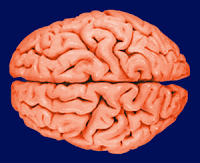
Dyslexia is a physical difference in the brain that gives rise to a fairly well established cluster of differences in functioning - positive and negative. It is not - as its name implies, and Stringer clearly believes - a synonym for illiteracy.
As to the assertion that: "if you cannot accurately define or diagnose something then it cannot be said to exist" - science progresses by making observations of phenomena that are imperfectly understood, forming hypotheses and then testing them.
Dyslexia was a term coined to described a perplexing phenomenon. Since that time understanding has increased. But no one would say that it is yet fully understood. Far from it. Perhaps, when the science of the brain has progressed further it will turn out to be more than one condition. I would think that is highly likely.
Early medicine might have described many different illnesses with the same words - “a fever” perhaps, or a “congestion of the lungs”. It took developments in medicine before the specific causes could be identified - different varieties of flu, which can only now be defined genetically. H1N1 flu existed before it could be properly defined or diagnosed.
Dyslexia exists also.
Wednesday, May 06, 2009
Gender Author and Character in fiction
One of the members of last week’s book group told me that when she realised the protagonist of BACKLASH was female and the author was male, she started looking for mistakes. The character would, she reasoned, say or do something that gave away my male personality. This suspicion lasted five or six chapters. But having found nothing ‘wrong’ in that time, her resistance softened and she accepted the genuine femaleness of the character. There was an animated discussion on this and I promised to write an article in response.
My editor at Simon & Schuster told me a very similar story. She’d assumed I wouldn’t be able to carry off a female point of view successfully in a first-person narrative. Her reading of the opening chapters was through that lens of suspicion. But then the character made an observation that was so true to my editor’s understanding of how a woman would see things, that credibility was established.
Of course, I asked the reverse question. If a woman was writing a first-person account from a male point of view, would she have the same apprehension? She said yes. But I suspect in general that people’s reactions might be fractionally different for a woman writing as a man.
There is also a supplementary question: if a male author were to write a third-person point of view with a female protagonist (as I did in BURNOUT) would that be equally difficult to accept? Again, I don’t think the reaction would be quite as strong.
My editor at Simon & Schuster told me a very similar story. She’d assumed I wouldn’t be able to carry off a female point of view successfully in a first-person narrative. Her reading of the opening chapters was through that lens of suspicion. But then the character made an observation that was so true to my editor’s understanding of how a woman would see things, that credibility was established.
Of course, I asked the reverse question. If a woman was writing a first-person account from a male point of view, would she have the same apprehension? She said yes. But I suspect in general that people’s reactions might be fractionally different for a woman writing as a man.
There is also a supplementary question: if a male author were to write a third-person point of view with a female protagonist (as I did in BURNOUT) would that be equally difficult to accept? Again, I don’t think the reaction would be quite as strong.

One of the questions often raised when the actions of fictional characters are being examined is: would a man/woman behave in such a way? Is the character true to their gender? The question is based on a huge assumption, however: that there is more character difference between the genders than there is within each gender.
We know that there are occasionally women who have what we might call a masculine personality and men who have what we might call a feminine personality. When we meet these people in reality, we accept them as what they are - perhaps musing to ourselves that their character is interesting or unusual. Paradoxically, when we met them in fiction we sometimes reject them saying: I don’t believe a woman/man would think like that.
This touches on one of the key differences between fiction and reality. Fiction has to be believable, whereas we have no choice but accept the things that reality serves up for us - however outrageously unlikely they may be.
The question for writers is: how do we allow our readers to get to the point of accepting that a character is truly male or female – especially when we are the opposite? I have two possible approaches to suggest.
The first is to offer your reader early evidence that you as a writer are able to get the characterisation spot-on. Somewhere near the beginning of the book, make an observation that is so perfectly gender correct that your readers drop their suspicions - just as my editor did. After that point, all the quirky stuff the character does or says will be taken as individuality. But try not to push it too far because the bubble of belief can be burst all too easily.
The second approach is to have another character express the view that your protagonist has a quirkily atypical personality – a peculiarly feminine male or masculine female. Once a facet of character has been observed within the book as unusual, the audience may just drop their fear that the writer has made a mistake.
Even if he/she has.
But as with all these things, I regard myself as a learner. If you have any insights on the question of gender and characterisation, do leave a comment below.
Google Book Settlement - update
More news on the Google Book Settlement.
The long running saga of the Google Book Settlement seems about to get longer. It kicked off when Google's decided to scan libraries of books in order to make them available through the Internet - without asking all the authors for permission first.
Some authors didn't like this and a case started to trundle forward along expensive legal rails. As a result a settlement has been reached between Google and an American body representing the interests of authors.
The word 'settlement' might be misleading here. It is not quite settled. There was a deadline for authors to register their desire to opt out and not have their work made available online. The deadline would have passed yesterday (May 5th) but has been extended to September 4th 2009.
The long running saga of the Google Book Settlement seems about to get longer. It kicked off when Google's decided to scan libraries of books in order to make them available through the Internet - without asking all the authors for permission first.
Some authors didn't like this and a case started to trundle forward along expensive legal rails. As a result a settlement has been reached between Google and an American body representing the interests of authors.
The word 'settlement' might be misleading here. It is not quite settled. There was a deadline for authors to register their desire to opt out and not have their work made available online. The deadline would have passed yesterday (May 5th) but has been extended to September 4th 2009.

A 'Fairness Hearing' is due to take place on October 7th 2009. I'm no expert in these things, but advice has been put to me to hold off from doing anything (either opting out or registering my titles) for the time being.
Tuesday, May 05, 2009
Writing Weekend part 2
Sunday.
Day two of the Writers’ Weekend. A bright, clear morning with dizzyingly beautiful views over the wide valley. I took off early for a walk with my camera, trying to catch that distinctive early-morning light. When I take photographs, in a doomed attempt to capture visual moments, I am also learning how to write. So much of the process of writing is about learning to really see the world.
Day two of the Writers’ Weekend. A bright, clear morning with dizzyingly beautiful views over the wide valley. I took off early for a walk with my camera, trying to catch that distinctive early-morning light. When I take photographs, in a doomed attempt to capture visual moments, I am also learning how to write. So much of the process of writing is about learning to really see the world.

Then more workshops. Two highlights for me were a workshop on synopsis writing given by Terri Bradshaw and one on editing poetry, given by Siobhan Logan. I learned about the subjects in question and approaches to teaching them.
I’d been trying to get Internet access and was told that I could use an unsecured wi-fi network based in one of the buildings on the site. I took my laptop out and sat next to the building in question – getting a strong and hopeful signal. But on trying to connect, my computer informed me that it had: “Failed to connect due to an unknown reason.” Blogging from the weekend was not to be. I contented myself with walking around the house, admiring the quirky little details that set genuinely old buildings apart from impressions of history recreated on interior design lifestyle shows.
That evening, after a very enjoyable meal and a session of joke telling (during which I learned that the Scandinavian nations tell very rude stories about each other) I decided to drive back through the night rather than waiting until the next morning to return to Leicester. What did I get out of the experience? (Other than a need to exercise. That food was far too good.)
In all the rush and focus on product that are part of my life as a writer, I sometimes forget what it is all really about. The writing weekend put things back in perspective. Spending time with writers. Talking about craft and creativity. Listening to other people's hopes and uncertainties. All this has left me feeling more centred in what I am doing.
And so, with that, it is back to the screenplay with renewed enthusiasm and a determination to enjoy the journey.
Monday, May 04, 2009
Writing Weekend - Cotswolds - Day 1

INT. ANCIENT COTSWOLD FARM BUILDING – DAY
Fifteen writers sit around a long dining table. Outside the window, the hill slopes away towards the patchwork of fields in the valley floor. Steam rises from a tureen of soup. A basket of French bread pieces is passed from hand to hand. The voice of children’s writer CHRIS D’LACEY rises above the murmur.
D’LACEY
Fifteen writers sit around a long dining table. Outside the window, the hill slopes away towards the patchwork of fields in the valley floor. Steam rises from a tureen of soup. A basket of French bread pieces is passed from hand to hand. The voice of children’s writer CHRIS D’LACEY rises above the murmur.
D’LACEY
I hope you all notice how expertly torn the bread is.

Yes, it is our self-catering weekend away. Self catering in every sense food, organisation, writing classes, entertainment.
I’ve been on writing weekends at Middle Stanley farm several times. On each occasion it has been hard to put my finger on what exactly I’ve learned. But I have learned. It is intangible knowledge, absorbed by osmosis rather than injected through instruction. Each time I have also come away inspired to write.
It is day one. This morning we had two sessions. The first focused on dialogue. How can we make dialogue work for us? How can we differentiate the voices? The second session was on scriptwriting and the differences between screen, stage and radio. Groups of us took the same scene and interpreted it for the three different media. Fascinating. I joined up with the group who were looking at stage play – as that is what I have least experience of.
And now it is the afternoon. We have all gone our different ways. Some are writing. Some walking in the hills. I suspect that one or two may be having a nap. For Myself, I’ve spent an hour writing up the scenes that Ivory and I were working on via Skype yesterday. (Was that only yesterday? It feels like a week ago.) I’m taking out a few minutes to write this. Then it’ll be back to White Angel again.
Frustratingly, I can’t get on the Internet, so I will have to save this up and post it as soon as I can get a connection. ...which turns out to be two days later
Note: I know the screenplay format above is wrong. Please blame Blogspot not me :-)
Friday, May 01, 2009
Skype and Collaborative Writing
Yesterday's consultation with Ivory took place upstairs in Cafe Nero. We laid out a hard copy of the White Angel 2 treatment and the beginning of the screenplay and started talking through the scenes.
I love this part of the process - when you begin to explore scenes in detail. Up until that point the scenes have been a sequence of necessary events, taking the character from opening stasis, through to final resolution. But when you begin to unpack them - that is when the real texture of character and story start to be revealed. Most of us tend to start out with characters and situations that have been 'seen before'. But as you explore them, you start to make discoveries that move the story into fresh ground.
Unfortunately our meeting was sandwiched between other meetings, so we ended up with less than an hour before having to rush off. The deal was that we'd meet up again today. Somewhere. A pub in Great Glen, perhaps? It was all rather vague.
But today the idea came to me (duh - slap palm to forehead) that we could meet via Skype. Which is what we did. We had two and a quarter hours of excellent consultation this morning. Typing and talking and surfing the Internet for research images.
The good news is, it worked really well. This approach is going to enable us to grab an hour here and an hour there through the week, even though we live in different towns. We could live on different continents and it would still be do-able. I feel as if I am belatedly stepping into the modern world.

However, in a few hours, I'm heading back in time to an ancient manor house in the Cotswolds. It will be a weekend of writing workshops and the company of creative people. If I can't get an Internet connection, there will be a few days of silence before I can post again. Otherwise I'll try my best to share the experience.
I'm SO lookign forward to it.
I love this part of the process - when you begin to explore scenes in detail. Up until that point the scenes have been a sequence of necessary events, taking the character from opening stasis, through to final resolution. But when you begin to unpack them - that is when the real texture of character and story start to be revealed. Most of us tend to start out with characters and situations that have been 'seen before'. But as you explore them, you start to make discoveries that move the story into fresh ground.
Unfortunately our meeting was sandwiched between other meetings, so we ended up with less than an hour before having to rush off. The deal was that we'd meet up again today. Somewhere. A pub in Great Glen, perhaps? It was all rather vague.
But today the idea came to me (duh - slap palm to forehead) that we could meet via Skype. Which is what we did. We had two and a quarter hours of excellent consultation this morning. Typing and talking and surfing the Internet for research images.
The good news is, it worked really well. This approach is going to enable us to grab an hour here and an hour there through the week, even though we live in different towns. We could live on different continents and it would still be do-able. I feel as if I am belatedly stepping into the modern world.
However, in a few hours, I'm heading back in time to an ancient manor house in the Cotswolds. It will be a weekend of writing workshops and the company of creative people. If I can't get an Internet connection, there will be a few days of silence before I can post again. Otherwise I'll try my best to share the experience.
I'm SO lookign forward to it.
Subscribe to:
Posts (Atom)