Friday, October 15, 2010

MuBu: the Newark Houses Museum

Miles Travelled = 124.7
Museums Visited = 4
Mood = Slightly Embarrassed


The Newark Houses Museum is a last minute call. They’re having a MuBu project event. Something to do with videos. Would I be free to go along?

So, innocent of any knowledge about the project, or indeed the place, I hurry into Leicester, find the museum and present myself at reception.

It is at this point that I need to make another confession...

Read the complete article at the MuBu Writer in Residence website.

Newark Houses Museum, Leicester

Monday, October 11, 2010

EDL demonstration and One Leicester celebrations

Two days ago, a group called the EDL came to leicester and staged a violent demonstration regarded by most external observers as anti-Muslim. Yesterday the people of Leicester responded with a celebration of unity in diversity. It may not surprise you to learn that the two events were not reported in the same way.

The following is the text of a letter of complaint I am sending to the BBC:

A news organization has a responsibility to report political issues in an even-handed way. Thus a statement from a spokesperson of one party is typically followed by an answering statement from the others.

So where was the balance last weekend in the BBC’s reporting of events in Leicester? The EDL had arranged a demonstration for Saturday, viewed by many as anti-Muslim. The City Council urged those people in Leicester who wished to present an opposing view to avoid direct confrontation, but instead to come into the city on the following day and demonstrate the fact that we as a city embrace and celebrate our religious and ethnic diversity.


The BBC, along with other news organizations, turned up and covered the EDL demonstrations. But what national news coverage did the city’s response to the EDL receive? I searched in vain for any coverage of Sunday’s huge celebration – which frankly dwarfed the EDL’s event.

One Leicester following the EDL demonstration
How can the BBC justify such bias in its coverage of a political issue? The coverage is not just misrepresentative, it is also in itself damaging. At the very least, equal time should have been given to the city’s response.

If your answer is that the events on Sunday were not reported because there was no street violence, then you are telling the world that violence is an effective means of getting a message heard. Should that be the message of the BBC?

I'm adding this note following a call from someone who works for BBC Radio Leicester: The local radio did cover the One Leicester celebration. What is more, the local paper, the Mercury, has had excellent coverage. My point here is the stark imbalance in like-for-like coverage at the national level. I listened to equivalent news broadcasts on Saturday and Sunday evening and found the EDL demo had been covered but not One Leicester.

Saturday, October 02, 2010

Poetry Exhibition

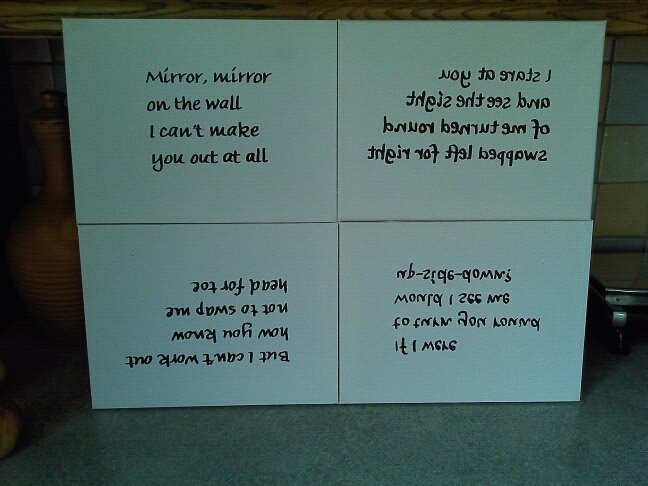
The word 'Exhibition' usually goes along with the word 'Art'. But next week it will be combined with the word 'Poetry'. Yes, Leicester is having what may be its first ever poetry exhibition.

Having been asked many months ago to contribute a piece, and with the deadline tomorrow, I have finally got my piece finished a few moments ago.

The road has been long and twisting. I set out with one idea - a poem in ceramics. But that somehow didn't get off the ground. Then came the idea of a different poem in metalwork. I researched this, had much helpful input from various people who have far more technical know-how than me, accumulated the required materials, then realised it was too difficult in the time I had remaining.

Then came the third idea - one of my short published poems written in letters variously rotated and flipped. And Now it is done. Though I still have to figure out how to attach the mirrors people may need to help them read the thing.

If you are in Leicester next week, head down to the Independent Arts Centre on Humberstone Gate. The exhibition will be upstairs.


As for the poem in metal - I still intend to create this. A project for the longer term perhaps.

Tuesday, September 21, 2010

MuBu Blog: Foxton Locks


Miles Travelled = 37.5
Museums Visited = 1
Mood = Awe


I’d been to Foxton before. I went to watch narrowboats making unhurried progress up and down the famous staircase of 10 locks and to marvel at the remains of the lift that once winched wider beamed barges between the upper and lower levels of the canal. I also went to walk the towpath and enjoy the peace and abundant wildlife.
But I never went into the museum.

Why? I now blush to admit that, having paid £2 to park the car, I didn’t want to hand over a further £2.50 to look round the collection. Miserly, I know.


Foxton Canal Museum
But as it turns out, Foxton Canal Museum is the first stop on my journey around the heritage sites of the East Midlands...

For the full article please go to Digital Writer in Residence blog on the MuBu website.

Monday, September 20, 2010

MuBu Digital Writer in Residence

I've just started working as Digital Writer in Residence for an East Midlands Museums project called 'MuBu'. I've been hinting at this for some time, but haven't been able to be more open about it because we were going through the usual administrative hurdles and getting the project web pages established.

But we are now up and running, so...


MuBu Digital Writer in Residence
Here is a link to the MuBu Digital Writer in Residence project page.

I won't be duplicating all my MuBu blog articles here, so if you'd like to follow the journey, you could subscribe or bookmark that site.

And please give feedback here or there if you feel able. It's all very pleasant seeing web traffic statistics and knowing, in an abstract sense, that a couple of hundred people have visited the site today. But feedback is the lifeblood of the blogger.

Wednesday, September 15, 2010

Generating Story Ideas

Where to find seed ideas for stories? Here are five ideas and observations:

Many stories come from asking questions. What would happen if... Thought is free so be as wild as you like. What would happen if a whale materialised high above the planet? No, wait, someone already wrote that one.

Stories can come from extrapolation. Read the driest news article from the most serious paper, then ask yourself about the people the story implies. The people in the background.

Don't be afraid of using up all your story ideas. The more stories you tell, the faster you'll find new ideas coming to you. The world is full of stories. All we have to do is train ourselves to notice them.

Other people's lives are a great source of story ideas. Happily, people love to talk about themselves. It is their favourite subject. Be a good listener and you'll have more stories than you can write.

I have a faulty digital radio that cuts out at random, usually leaving sentences unfinished. It's exasperating at times, but perfect for a storyteller. When the radio dies, my mind jumps forward, trying to complete the story.

And I am willing to sell this faulty digital radio/story generating machine. All reasonable offers considered. Now, that gives me an idea for a story...

Pure Digital Radio

Friday, August 20, 2010

2D Cinema vs 3D

The 2D vs 3D cinema debate rumbles on, though the studios seem committed to the new technology.

In the old days of cinema, before polarising glasses, I never used to sit irritated in the dark thinking - this is far too flat for me. Why? Because through the art of the cinematographer, the image projected onto the 2D screen had 3D depth.

It is a trick of the mind and the eye so subtle that I was never even aware of it until I started to make films myself. The subject - the thing on the screen which the film maker wanted to direct my eye to - was in perfect focus. Other things, closer to the camera or further away, were softened. The slightest of out-of-focus blur.

This so closely maps onto the way we experience depth of field in everyday life that in watching a 2D movie, the mind tells us some things are further away and other things closer. A flat screen becomes 3D.

But in the old days those three dimensions were trapped behind the screen. Modern 3D extends out into the space between the screen and the audience. It offers that spooky moment when the Cheshire Cat hovers in the air just in front of you and speaks in Stephen Fry's voice.

3D vs 2D Cheshire Cat
For that moment of magic however, a payment is required. A thirty percent loss in colour. The hassle of having a pair of uncomfortable glasses pressing down on your nose - over your own glasses if you are short sighted like me. And a substantially more expensive cinema ticket.

There is also a strange mismatch between the old and the new systems of indicating depth. The subject is still in focus, the background and foreground are out of focus. But now some of those out of focus things are floating around in the air just in front of you. I find my eye is no longer pulled only to the thing I should be looking at, but jumps between things at different depths. They remain out of focus, which my brain finds hard to accept. The experience is disorientating and mildly unpleasant.

Perhaps we are in an age similar to the end of the silent era, when cinematographers were experimenting with the new technology and hadn't quite got it right. Or perhaps this is an unneeded technology. Time will tell. But for now, given the option, I'll be going for 2D screenings.

And here, for your enjoyment, is Mark Kermode and Simon Miller's revolutionary invention - glasses that allow you to see 3D screenings in spectacular, immersive 2D.

Tuesday, August 17, 2010

Dyslexia, Memory, Socrates and Smartphones

Socrates disapproved of writing. It was not an aid to memory he said, but a replacement. If people could use symbols on a sheet of paper to record information, why would they bother to develop the latent power of their minds?

Socrates was right. As literacy spread, the use of memorization techniques dwindled. The art of memorization used to be part of the foundation of learning. But from the time I entered primary school to the day I graduated from university, only one teacher bothered to tell me how to remember things.

Even he only mentioned memory two times (as far as I can recall). Once to let us know that there was a difference between short, medium and long term memory. And once, after using a particularly entertaining simile, when he told us that the ruder the imagery we connect to a memory, the easier it would be to hold on to. (Alas I cannot repeat the image that he shared with us that day because it would never get through adult web content filters.)

Few today would say that the exchange of literacy for memorization technique was not a trade worth making. But for dyslexics, who may have particular difficulty with short term memory, memorization techniques can still be very useful. The loci system, for example, which has become a powerful tool for me, turning an area of weakness into a strength.

Socrates Memory and Writing
But if writing was an anathema to Socrates, what would he have said about the information revolution?

Followers of this blog will know that I recently bought a Dell Streak smartphone/tablet to help me with organization. I've had it a week now and have discovered that it is helping me to remember things in a way I had not anticipated.

How long until the parking expires? When should I head in to town to the Writers' Club meeting? When will I need to collect my wife from the train station on Wednesday? Two dyslexic issues converge on questions such as these: short term memory and tracking the flow of time. But by using the calendar alarm on the Dell Streak, I now don't need to remember. This may sound trivial, but it removes the layer of background anxiety that goes with struggling to do something one is congenitally poor at.

What would Socrates say? He'd probably tell me to work on the memory rather than using an external solution. But perhaps by removing the anxiety associated with remembering times, the smartphone will give me the space to do just that.

We will see.

Thursday, August 12, 2010

Dyslexia the Dell Streak and Organization

Microsoft Word turned this dyslexic into a writer. Might the Dell Streak or some other smatrphone/tablet computer enable me to be super-organized?

I'm not one to harp on about the problems of dyslexia, as I am far more interested in the significant and often overlooked strengths. But here we do need to state the fact: dyslexics often have problems with organization. Find a really successful dyslexic and you will usually find a highly effective PA or partner standing close by.

Why is organization a problem? Because of a deficit in short term memory and problems tracking time/date combined an intense, creative tendency to make more lateral jumps than logical ones. I'm not going to show a photograph of my office to illustrate this. Even I blush sometimes. If you want to picture it in your mind, just meditate on the phrase 'creative chaos'.

Don't get me wrong, I wouldn't have my brain wired any other way. But this is a non-dyslexic world and I want to fit in if possible, so I'm always on the lookout for coping strategies.

Might the smartphone be the answer? Or perhaps a netbook computer? This is the question that has been tumbling in a pleasantly chaotic way around inside my head for the past year. My problem was that the netbook is just too big to carry round with me all the time - and thus would not work as a portable calendar. And the smartphone seemed just too small to read documents from with ease as well as some of the other features I was looking for. In short, I wanted something just in between these two classes of devices and nothing was on the market.

Enter the Dell Streak. Is it a tablet computer or a smartphone? A bit of both. In other words, it was exactly the class of device I was looking for.

Dell Streak
It is a calendar, an alarm clock, a note taking device, a camera to take photos of receipts etc, a voice recorder, access to the Internet and e-mails, lists of contacts, names of people, documents I would no longer need to carry, an infinite supply of maps and it would tell me where I am when I get lost. Oh, and it makes phone calls too.

I believe this kind of technology will make a huge difference for many adult dyslexics, liberating them to integrate more effectively with the non-dyslexic world. As to whether the Dell Streak will be THE landmark device in this respect - there was only one way for me to find out.

So two days ago I went out and bought one. Or rather, the Carphone Warehouse gave me one and I agreed to pay a £35 contract every month for the next two years. Was it worth it? I'll report on my progress over the coming months.

Monday, August 09, 2010

Baha'i leaders sentenced in Iran

I'm reposting the text of an article from Iran Press Watch. I don't usually repost other people's material, but this report covers such an outrageous breach of human rights that I feel compelled to share it as widely as possible. You can find the original article here.

A total of 140 years of prison for the seven Baha’i directors

August 9th, 2010

Hrana News – Each of the 7 former leaders of the Baha’i community has been sentenced to 20 years of imprisonment.

As reported by the Committee of Reporters on Human Rights, this sentence comes after more than 2 years that they had been detained in prison, with repeated illegal orders. Previously, many times the court sessions had been postponed but in recent months, after holding several court sessions, finally the 20 year sentence of imprisonment has been handed down to their lawyers.


Six of the seven Baha’i citizens who were responsible for attending to the affairs of Baha’is in Iran have been detained since 25 Ordibehesht 1387, following coordinated attacks by the security forces of their homes. The seventh, Mrs Mahvash Sabet had been arrested in Mashad previously, on 15 Esfand 1386.”

Tuesday, July 20, 2010

The hidden benefits of Dyslexia

The term 'dyslexia' was first coined over a hundred and twenty years ago to describe students who had no deficit in intelligence but were nevertheless having difficulty acquiring literacy. It seemed a logical name. Dys-lexia. A problem with words.

Since that time, studies of dyslexia have naturally focused on helping dyslexic children lean to read and write. No surprise there. Get 100 dyslexics together and you will indeed have a crowd of people who have experienced difficulty with aspects of literacy. But look more closely and other quirky characteristics are revealed.

For example, many of the 100 dyslexics will have difficulty naming their left and right sides. Some may have problems reading the time from an analogue clock. Tracking the flow of time, short term memory and remembering names could also be an issue. Over the years researchers have been able to identify a cluster of such non-literacy-related problems.

But if you do get that group of dyslexics together and give them time to talk and compare notes, other commonalities start to emerge. For example, dyslexics are often very creative. They are lateral thinkers and problem solvers. Given a complex set of interrelationships, they easily see the whole picture and get to the root of issues. Many are able to read other people's emotions with stunning clarity.


No surprise then that so many successful people from the world of creative arts and the world of entrepreneurial business turn out to be dyslexic. Enhanced ability to think in three dimensions is another common attribute. Thus the ranks of top architects are also rich in dyslexics.

If we were to ask our group of 100 dyslexics whether they would like to be 'cured' of dyslexia - having the problems AND the advantages simultaneously removed by swallowing a pill - what would they say? What would you say? For me it would be an emphatic NO.

Not so much a learning disability, then. More a learning difference that manifests as disability in some situations (particularly in school) and manifests as a prodigious ability in others.

Sunday, July 04, 2010

The difference between Story and Reality

What is the difference between story and reality? According to Mark Twain: "Fiction is obliged to stick to possibilities. Truth isn't."

Tom Clancy made a similar observation: "The difference between fiction and reality? Fiction has to make sense." However, he also commented on the overlap between the two: "I've made up stuff that's turned out to be real, that's the spooky part."

In his superb filmmaking masterclass last month, Chris Jones said: "The brain cannot tell the difference between a story and reality." That is why we cry watching a sad movie and scream watching horror. He also said: "Stories are about communicating truths not facts."

My take on it is this: Reality is a tangled knot made from an infinite number of threads. The full blinding complexity and intensity of it is available for us to experience in the 'now'. But as soon as events have past and we look back on what has happened, we start to order our memories into a narrative. From the tangle, we extract a single thread. That becomes the reality of our past.

As storytellers we do the same thing - extracting one thread from the mass of possibilities, cutting it to make a beginning and cutting it again to make an end. Then we present that to our audience.

Friday, July 02, 2010

Podcast extract from Vintage by Maxine Linnell

I recently had the pleasure of recording Maxine Linnell reading an extract from her new time-swap novel 'Vintage', in which a contemporary teenager swaps places with a counterpart from 1962.

I'm podcasting the recording here, partly to recommend the novel (which is excellent) and partly to experiment with embedding audio files in blogger - which I hope to do much more of in the coming months.
For those of you interested in the recent technical discussion of microphones and field recorders, this recording was made on my Sony Z1 camera, and not with the Marantz PMD661 - which I hadn't bought at the time of recording.

Note: As I write this additional note, the podcast link has stopped working. The audio file hosting site seems to be down - so that is probably the reason. I will clearly have to look for other solutions.

Thursday, July 01, 2010

New Microphone

A couple of days ago, I wrote about the Marantz PMD 661 field recorder. I'm still extremely pleased with the way it works with my Rode shotgun microphone. That covers my film making needs. But I do intend to use the recorder for audio interviews in the near future, and realised that a different kind of microphone is necessary for that.

For that usage I need an omnidirectional rather than a shotgun microphone. I also need it to have shielding to prevent all that nasty handling noise. I don't have a background in audio technology, so need to rely on reviews to guide my choice of equipment. This was fairly easy with the field recorders - which are extensively reviewed on the Internet. But with microphones I had a harder time. It seems that very few people choose to review microphones. Perhaps I shouldn't have been surprised to discover that.


I eventually decided on the AKG D230. I managed to buy a second hand one on Ebay - which should arrive sometime in the next couple of weeks. When it does I will offer my own very inexpert review.

As for the question of what audio interviews am I intending to conduct - it is connected to my interest in dyslexia. I'll say more about that in a future blog post.

Followers