The Virgin Media broadband fiasco continues. Late yesterday the household was blessed with connectivity and I managed to post up the blog entry I’d written earlier. The problem, it seemed, was solved. However, at 8.30 this morning I turned on the modem and found no service yet again.
I am now a master of the Virgin Media helpline system. Not through any natural ability. Rather, through repetition. I phoned up, keyed in the numbers before the voice could ask me for them and was put through to a charming Indian man who asked me to turn things off and turn them on again, report on which lights flashed and which lights didn’t, tell him which operating system I was using and eventually informed me that there was a problem in my area but engineers were working on it and the service would be back by 6pm.
‘How many more days will the service be out?’ I asked.
‘It will be back by 6pm today.’
‘That’s what I was told yesterday.’
‘Yes.’
‘And the day before. And the day before that.’
‘Yes.’
‘So when will this problem be over?’
‘At 6pm today.’
Whatever they are paying their helpline staff it isn’t enough. The guy must be
facing a screen which tells him to tell me this stuff. It is ludicrous, frankly. He knows it. I know it. But he delivers the lines faultlessly. He is polite, concerned and does not deviate a hair’s breadth from the script. I’ve spoken to seven or eight of these helpline workers in the last week. They have all been charming.
It seems that Virgin media have wisely invested in their complaints department. Shame about the broadband service.
If you are a Leicester customer of Virgin Media and are having problems could I suggest you phone the helpline on 151. Key in the numbers 2 followed by 3 and wait while it tells you to turn everything off and then on again. They’ll play you a bit of music, then someone will speak to you. Ask for a refund and they should credit you £5. Today I asked for a substantial refund and was told I would be credited £10. Tomorrow I intend to ask for an enormous refund.
But then again, if you are a Leicester Virgin Media broadband customer you probably won’t be able to read this.
Friday, September 18, 2009
Thursday, September 17, 2009
Virgin Media – Broadband Service Review
Virgin Media’s broken broadband service is to blame for the lack of blog entries this week. Yes, let’s say that again so that the search engines find this page. My customer review of Virgin Media’s broadband service: in my recent experience it is highly unreliable.
For the last week or so Virgin Media broadband has been cutting out for chunks of five or ten minutes at a time. Then three days ago the service stopped completely. I called the help line and discovered I was not alone. The entire LE3 postcode area was apparently experiencing problems. No broadband and no cable television. But all would be well by 6pm. That’s what I was told.
The forecast proved correct. By 6pm we were up and running again. The problem was over.
Except that it cut again the following morning. I was getting used to the automated help line by this time and, having memorised the route through the maze, could key in the various number choices without waiting to be prompted by that insufferably cheery voice.
Yes there was a new problem, they said. A faulty fuse somewhere. But all would be well later on very soon.
When it happened again today I began to see a pattern. The service is on until work starts in the morning and then off until work finishes in the evening.
‘I suspect your engineers may be cutting me off,’ I said to the helpline worker.
‘Yes,’ she said. ‘They are working to upgrade your area. But it will all be over soon.’
‘This was planned?’
‘Yes,’ she said.
‘Then why didn’t Virgin Media bother to tell its customers?’
‘It will be up and running by 6pm,’ she said.
‘And tomorrow?’
‘Your area is being upgraded.’
So here I am, composing my blog entry offline in the hope that the Virgin Media engineers may have a tea break and let me back onto the Information Superhighway at some stage.
Coincidentally, Virgin Media just hiked the price of their broadband. The justification? The service was going to be better.
Mr Branson, you are a highly successful dyslexic, an inspiration to dyslexics like me. But your Virgin brand is not looking so shiny right now. Quite frankly this service is shoddy.
For the last week or so Virgin Media broadband has been cutting out for chunks of five or ten minutes at a time. Then three days ago the service stopped completely. I called the help line and discovered I was not alone. The entire LE3 postcode area was apparently experiencing problems. No broadband and no cable television. But all would be well by 6pm. That’s what I was told.
The forecast proved correct. By 6pm we were up and running again. The problem was over.
Except that it cut again the following morning. I was getting used to the automated help line by this time and, having memorised the route through the maze, could key in the various number choices without waiting to be prompted by that insufferably cheery voice.
Yes there was a new problem, they said. A faulty fuse somewhere. But all would be well later on very soon.
When it happened again today I began to see a pattern. The service is on until work starts in the morning and then off until work finishes in the evening.
‘I suspect your engineers may be cutting me off,’ I said to the helpline worker.
‘Yes,’ she said. ‘They are working to upgrade your area. But it will all be over soon.’
‘This was planned?’
‘Yes,’ she said.
‘Then why didn’t Virgin Media bother to tell its customers?’
‘It will be up and running by 6pm,’ she said.
‘And tomorrow?’
‘Your area is being upgraded.’
So here I am, composing my blog entry offline in the hope that the Virgin Media engineers may have a tea break and let me back onto the Information Superhighway at some stage.
Coincidentally, Virgin Media just hiked the price of their broadband. The justification? The service was going to be better.
Mr Branson, you are a highly successful dyslexic, an inspiration to dyslexics like me. But your Virgin brand is not looking so shiny right now. Quite frankly this service is shoddy.
Monday, September 07, 2009
Sunday, September 06, 2009
The cost of a Paperback
The year is 2020. It costs £5 to buy a paperback novel. £3 if it is one of the few hundred titles being stocked on the shelves of your local supermarket. Most of that money is needed to cover the direct costs of producing the physical book. Ink, paper, printing and binding. Some is needed to cover transport. The shop takes a chunk to cover its overheads and to keep its shareholders happy. How much goes to the author? A few pence per copy.
Alternatively you can buy your novel as a download and read it on your shiny new book reader. How much for? There is no printing, no transport and no shelf stacking. Shall we say, fifty pence for the author and fifty pence to cover the website design and management?
What about a third possibility – read the book online courtesy of Google and see a few adverts along the way. The author gets a few fractions of a penny from the advertising revenue. You pay nothing.
What do publishers do in this crisp new digital world? They have already out-sourced the job of selecting the best novels. Literary agents do that. As for editing – literary agents increasingly take a hand in that too. Cover design is usually subcontracted. Publishers rarely spend money on advertising for authors who are not already famous. All that is left is the sales team who work so hard going bookshop to bookshop. But with digital distribution, the bookshops are not needed.
A world without publishers?
It is a world in which anyone and everyone can publish by themselves. Digital distribution – costing so little it is basically free – makes this easy. I am lucky enough to have seen many as yet unpublished but wonderful books in manuscript form. But I have seen a far larger number of badly written manuscripts. In 2020 are all of them being published?
Alternatively you can buy your novel as a download and read it on your shiny new book reader. How much for? There is no printing, no transport and no shelf stacking. Shall we say, fifty pence for the author and fifty pence to cover the website design and management?
What about a third possibility – read the book online courtesy of Google and see a few adverts along the way. The author gets a few fractions of a penny from the advertising revenue. You pay nothing.
What do publishers do in this crisp new digital world? They have already out-sourced the job of selecting the best novels. Literary agents do that. As for editing – literary agents increasingly take a hand in that too. Cover design is usually subcontracted. Publishers rarely spend money on advertising for authors who are not already famous. All that is left is the sales team who work so hard going bookshop to bookshop. But with digital distribution, the bookshops are not needed.
A world without publishers?
It is a world in which anyone and everyone can publish by themselves. Digital distribution – costing so little it is basically free – makes this easy. I am lucky enough to have seen many as yet unpublished but wonderful books in manuscript form. But I have seen a far larger number of badly written manuscripts. In 2020 are all of them being published?
Friday, September 04, 2009
Google Book Settlement
The Google Book Settlement debate is heating up. Hundreds of millions of dollars are on the table. It seems like a lot of money until you remember that it is the entire future of writing and publishing industry that is being shaped.
In yesterday's blog post I wrote about business models in which artists give their work away for free. But here we seem to have a business model in which an artist's work is given away by someone else.
The crux of the matter is this - Google took it upon themselves to digitize huge numbers of books in order to offer them in whole or in part through the Internet. Some of these books would be out of copyright - in America if not in the UK. In other cases the copyright holders could not be found. And where a copyright holder could be found, some money might flow back to them from Google.
Although an author opt-out has now been offered by Google as part of the legal settlement, some authors are less than happy to have had so little say in the formation of the deal. There is also disquiet among the other Internet giants, who are presumably worried about the hold Google is going to gain over the digital distribution of books - which is surely the future of publishing.
Google has been parading supporters of the deal ahead of any final legal decision. One advocate apparently said: "We see access to knowledge as a civil right. Information enables individuals to learn, to create and to pursue their dreams. Access to knowledge defines the meaning of equal opportunity in a democratic society."
Hard to argue with that. Who would vote against spreading knowledge? Until you remember that the 'knowledge' being offered includes the creative work of individuals. You and me.
Is this the future of publishing: that all creative work will be accessed for free, and interspersed with adverts, from which revenue a trickle will return to the authors? Is the concept of copyright now so unworkable that this becomes the only way for artists to make a living?
In yesterday's blog post I wrote about business models in which artists give their work away for free. But here we seem to have a business model in which an artist's work is given away by someone else.
The crux of the matter is this - Google took it upon themselves to digitize huge numbers of books in order to offer them in whole or in part through the Internet. Some of these books would be out of copyright - in America if not in the UK. In other cases the copyright holders could not be found. And where a copyright holder could be found, some money might flow back to them from Google.
Although an author opt-out has now been offered by Google as part of the legal settlement, some authors are less than happy to have had so little say in the formation of the deal. There is also disquiet among the other Internet giants, who are presumably worried about the hold Google is going to gain over the digital distribution of books - which is surely the future of publishing.
Google has been parading supporters of the deal ahead of any final legal decision. One advocate apparently said: "We see access to knowledge as a civil right. Information enables individuals to learn, to create and to pursue their dreams. Access to knowledge defines the meaning of equal opportunity in a democratic society."
Hard to argue with that. Who would vote against spreading knowledge? Until you remember that the 'knowledge' being offered includes the creative work of individuals. You and me.
Is this the future of publishing: that all creative work will be accessed for free, and interspersed with adverts, from which revenue a trickle will return to the authors? Is the concept of copyright now so unworkable that this becomes the only way for artists to make a living?
Wednesday, September 02, 2009
Giving it away - a business model
Making money by giving things away free seems, on the face of it, to be a contradiction. But I have recently noticed several people who have done just this - and done it with great success.
But first an example of the traditional business model. This morning I found a podcast about a subject I was interested in. Naturally, I started listening to it. I hoped to get some free advice from a person who knows what he is talking about. What I actually heard was a sales pitch for a workshop from person who apparently knows what he is talking about. He hinted at the content of his workshop without actually giving any details. The method was named but not described.
And who could blame him? If I could get the content for free, why would I sign up for the course? This is the traditional business model.
But here are three examples of people who have become successful through giving things away for free.
1) David Blaine the street magician. Think back before the endurance stunts. He made his name by approaching people on the street and giving free magic shows. And not just the casual coin disappearing stuff that your uncle does to amuse the kids. These were sophisticated illusions which must have taken much time and effort to perfect and set up.
Of course, he had someone with a camera there to film it all. And he would later sell the show to TV stations. But at the point of origin, he was apparently giving something away.
2) How about the graffiti artist Banksy? Sneaking out in the night and spray painting works of art onto people's walls. Giving it away. Take a close look at his work and it becomes clear that a huge amount of thought, preparation and skill goes into what he does. People who find a Banksy on something that belongs to them can go and sell it if they want. It could easily be worth tens of thousands of pounds.

The public interest he has generated through this is so huge that money must be pouring in. I bought a copy of his book so I could enjoy the pictures. The very wealthy might buy an original canvas.
3) And if that doesn't convince you, how about the film maker Chris Jones? His blog is like a masterclass in the film industry. There is no sense that he is holding things back so we will be more inclined to buy one of his books or go to one of his workshops. He is open and frank about the projects he is involved with.
I have no idea if this was his idea from the start, but when he needed money to make a short film, he simply asked for £50 from everyone. And such was the respect his readers and other contacts held him in that they gave freely. The money came in and the film Gone Fishing was made. (I'm sure you already know, it reached the final shortlist of 10 films for the Oscars).
The outstanding feature of each of the above examples is that the artists didn't give away their leftovers. They gave away the very best.
But first an example of the traditional business model. This morning I found a podcast about a subject I was interested in. Naturally, I started listening to it. I hoped to get some free advice from a person who knows what he is talking about. What I actually heard was a sales pitch for a workshop from person who apparently knows what he is talking about. He hinted at the content of his workshop without actually giving any details. The method was named but not described.
And who could blame him? If I could get the content for free, why would I sign up for the course? This is the traditional business model.
But here are three examples of people who have become successful through giving things away for free.
1) David Blaine the street magician. Think back before the endurance stunts. He made his name by approaching people on the street and giving free magic shows. And not just the casual coin disappearing stuff that your uncle does to amuse the kids. These were sophisticated illusions which must have taken much time and effort to perfect and set up.
Of course, he had someone with a camera there to film it all. And he would later sell the show to TV stations. But at the point of origin, he was apparently giving something away.
2) How about the graffiti artist Banksy? Sneaking out in the night and spray painting works of art onto people's walls. Giving it away. Take a close look at his work and it becomes clear that a huge amount of thought, preparation and skill goes into what he does. People who find a Banksy on something that belongs to them can go and sell it if they want. It could easily be worth tens of thousands of pounds.
The public interest he has generated through this is so huge that money must be pouring in. I bought a copy of his book so I could enjoy the pictures. The very wealthy might buy an original canvas.
3) And if that doesn't convince you, how about the film maker Chris Jones? His blog is like a masterclass in the film industry. There is no sense that he is holding things back so we will be more inclined to buy one of his books or go to one of his workshops. He is open and frank about the projects he is involved with.
I have no idea if this was his idea from the start, but when he needed money to make a short film, he simply asked for £50 from everyone. And such was the respect his readers and other contacts held him in that they gave freely. The money came in and the film Gone Fishing was made. (I'm sure you already know, it reached the final shortlist of 10 films for the Oscars).
The outstanding feature of each of the above examples is that the artists didn't give away their leftovers. They gave away the very best.
Friday, August 28, 2009
How to publicise your novel
How to publicize your novel is a question most writers don’t start to worry about until the event is upon them. Let’s face it – there have been too many other things on our minds till then. Like writing the darned thing, finding an agent and getting an editor to be your new best friend. Important stuff. Publicity can wait.
But your publisher has been thinking about the selling of your book from the moment they read the drop-dead-brilliant opening lines: Where will this sit in the bookshop? What commercially successful titles is it similar to? Can I sell the book? Can I sell the author?
The hard truth of being a writer today is this: more books are being written than ever before, more titles are being published than at any time in history, but sales are not increasing. You do the maths.
Perhaps we should be thinking about publicity after all.
So here are some of the best known shortcuts to getting column inches and getting people talking about (and hopefully deciding to buy) your novel.
1) Have had a career as a journalist and therefore have lots of favours you can call in.
2) Be good friends with the author in-crowd so they will give you quotes to put on the back of your book and perhaps even write a review for the newspaper.
3) Be a celebrity. Or date a celebrity. Or get a celebrity to take out a restraining order against you. Or any combination of the above. (Or almost any other sentence that contains the word ‘celebrity’)
And if none of the above apply, how about these:
1) Put in time working with the local media. Keep knocking on their doors. Always say yes to their requests, even if they want you in the radio station to review the papers at 7am and won’t pay your bus fare. (Or be writer in residence in the local bus station for the morning).
2) Put time in working with the libraries and librarians in your region. Readers group after readers group. Year after year. These are your friends.
3) Over-prepare for every presentation. Even if you are giving away your time for free. If the local radio station has invited you in for 5 minutes of comment on the recent spate of fly-tipping, spend hours preparing, researching, rehearsing. Always shine.
4) If your novel wins something in a competition – even if it some small, local affair - start referring to it as an award winning novel. Keep honing and updating your biography.
5) Network with other writers, performers and artists. Go to their launch events. Be generous with your friendship. Support them and they will hopefully support you. And even if they don’t, it should be a pleasure.
6) Make each thing you write better than the last.
7) Have a website so people can find you when they need to.
8) And, yes, keep a blog.
But your publisher has been thinking about the selling of your book from the moment they read the drop-dead-brilliant opening lines: Where will this sit in the bookshop? What commercially successful titles is it similar to? Can I sell the book? Can I sell the author?
The hard truth of being a writer today is this: more books are being written than ever before, more titles are being published than at any time in history, but sales are not increasing. You do the maths.
Perhaps we should be thinking about publicity after all.
So here are some of the best known shortcuts to getting column inches and getting people talking about (and hopefully deciding to buy) your novel.
1) Have had a career as a journalist and therefore have lots of favours you can call in.
2) Be good friends with the author in-crowd so they will give you quotes to put on the back of your book and perhaps even write a review for the newspaper.
3) Be a celebrity. Or date a celebrity. Or get a celebrity to take out a restraining order against you. Or any combination of the above. (Or almost any other sentence that contains the word ‘celebrity’)
And if none of the above apply, how about these:
1) Put in time working with the local media. Keep knocking on their doors. Always say yes to their requests, even if they want you in the radio station to review the papers at 7am and won’t pay your bus fare. (Or be writer in residence in the local bus station for the morning).
2) Put time in working with the libraries and librarians in your region. Readers group after readers group. Year after year. These are your friends.
3) Over-prepare for every presentation. Even if you are giving away your time for free. If the local radio station has invited you in for 5 minutes of comment on the recent spate of fly-tipping, spend hours preparing, researching, rehearsing. Always shine.
4) If your novel wins something in a competition – even if it some small, local affair - start referring to it as an award winning novel. Keep honing and updating your biography.
5) Network with other writers, performers and artists. Go to their launch events. Be generous with your friendship. Support them and they will hopefully support you. And even if they don’t, it should be a pleasure.
6) Make each thing you write better than the last.
7) Have a website so people can find you when they need to.
8) And, yes, keep a blog.
Thursday, August 27, 2009
Sebastian Faulks, Dan Brown and Publicists
What do Dan Brown and Sebastian Faulks have in common? Perhaps a better question would be what do their publicists have in common? Happiness, I suggest. More column inches than you can shake a stick at. And all for free.
Dan Brown managed to inflame large portions of the worldwide Christian community through suggestions in his book The Da Vinci Code. The story is gripping enough but the prose is ropey and large parts of it seem unedited. If its ideological opponents had just kept their mouths closed it would have been forgotten within a couple of years. But the call of publicity proved too tempting. How many column inches were devoted to the argument? I would hazard a guess that it was many times that which was devoted to, for example, malaria. But then, no one is arguing about malaria. It kills between one and three million people a year. What’s to say?
Dan Brown managed to inflame large portions of the worldwide Christian community through suggestions in his book The Da Vinci Code. The story is gripping enough but the prose is ropey and large parts of it seem unedited. If its ideological opponents had just kept their mouths closed it would have been forgotten within a couple of years. But the call of publicity proved too tempting. How many column inches were devoted to the argument? I would hazard a guess that it was many times that which was devoted to, for example, malaria. But then, no one is arguing about malaria. It kills between one and three million people a year. What’s to say?

Sebastian Faulks an experienced journalist himself, knows a thing or two about the workings of the newspaper industry. He must have had a fairly shrewd idea of what would happen when he just happened to mention to a journalist that he’d read the Quran and found it: “a depressing book” and “the rantings of a schizophrenic” and “very one-dimensional”.
Coincidentally, he has a new book out.
 Of course, after that the papers were hungry for more coverage and he had a chance to say that he was quoted out of context and that he blamed himself really. “I am not the first and probably won’t be the last to have ruffled some feathers, though I feel sad about this, because my new novel, A week in December, is carefully researched, and, among its main characters, presents a hugely sympathetic and loving Muslim family”.
I can just imagine the publicist’s smile, that dreamy, far-away look.
So - if you are seeing signs of depression or stress in your publicist, the answer is simple. You need to stop messing around honing your prose and get down to work. Burn a flag or break an icon. Perjure yourself and go to prison. Sleep with someone famous and accidentally publish the video on Youtube.
You know it makes sense.
Thursday, August 20, 2009
Writer in Residence podcast
As promised, here is the link to the BBC Radio Leicester podcast from yesterday's 'Writer in Residence' extraviganza at St Margaret's Bust Station, Leicester.
The podcast covers the whole several hours of the program. But if you want to cut to the chase, the three sections in which I was involved can be found at:
0.41.08
1.34.21
2.37.55
Just shift the time bar along to find these bits of the show. The final section, at 2 hours thirty-seven minutes, is the bit we did from the studio, in which I read out my composition.
The podcast covers the whole several hours of the program. But if you want to cut to the chase, the three sections in which I was involved can be found at:
0.41.08
1.34.21
2.37.55
Just shift the time bar along to find these bits of the show. The final section, at 2 hours thirty-seven minutes, is the bit we did from the studio, in which I read out my composition.
Wednesday, August 19, 2009
St Margaret's Bus Station
The result of my two-hour writely residency this morning...
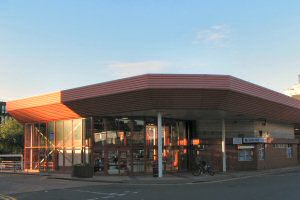
St Margaret's Bus Station
Stop to look
at the giant slab of the roof
bright blue
dropped between the ring road
and the dull red brick
of Sandacre and Short Street.
Inside
a high ceiling of steel beams
and concertinaed walls of glass
enclose a hall
one hundred and twenty paces end to end.
A room to wait and greet
where place names read like poetry:
Pool Meadow,
Three Pots,
Fosse Park,
St Margaret's.
Is this your drab commute
of diesel exhaust and sausage rolls
served in a greasy caff?
Or the set for Bond or Jason Bourne
to weave and dodge in hot pursuit.
Could it be a brief encounter's final scene?
A final touch
and the scent from a lover's skin.
St Margaret's Bus Station
Stop to look
at the giant slab of the roof
bright blue
dropped between the ring road
and the dull red brick
of Sandacre and Short Street.
Inside
a high ceiling of steel beams
and concertinaed walls of glass
enclose a hall
one hundred and twenty paces end to end.
A room to wait and greet
where place names read like poetry:
Pool Meadow,
Three Pots,
Fosse Park,
St Margaret's.
Is this your drab commute
of diesel exhaust and sausage rolls
served in a greasy caff?
Or the set for Bond or Jason Bourne
to weave and dodge in hot pursuit.
Could it be a brief encounter's final scene?
A final touch
and the scent from a lover's skin.
Writer in a bus station 2
I'm back from a very interesting morning in the company of BBC Radio Leicester, during which I mooched around St Margaret's Bus Station as a kind of writer in residence - or at least a writer in transit.
My task was to produce a short descriptive piece suitable to be read out on radio. And to talk to people milling around waiting for buses. All this was relayed live via the radio car and the ever helpful presenter, Jo Hollis.
Then it was back into the radio car, through the roadworks to the radio station - and a whole side of the place I hadn't seen before. For example, did you know they have a neat turntable just inside so they can get the radio car pointing in the right direction without all that messing around with forward and reverse gears? It's like a kind of low-key Thunderbirds. And then they plug it in to the mains. The radio car, that is, not the turntable.
Writer in residence in the bus station? They need a writer in residence in the radio station. There is so much neat stuff behind the scenes.
Then onto the studio with Tony Wadsworth to chat about the experience and read out my piece. I understand they will soon have the show available to listen to via podcast. When that happens, I'll post up the link.
As to what I wrote, I'll put that up as a separate post.
My task was to produce a short descriptive piece suitable to be read out on radio. And to talk to people milling around waiting for buses. All this was relayed live via the radio car and the ever helpful presenter, Jo Hollis.
Then it was back into the radio car, through the roadworks to the radio station - and a whole side of the place I hadn't seen before. For example, did you know they have a neat turntable just inside so they can get the radio car pointing in the right direction without all that messing around with forward and reverse gears? It's like a kind of low-key Thunderbirds. And then they plug it in to the mains. The radio car, that is, not the turntable.
Writer in residence in the bus station? They need a writer in residence in the radio station. There is so much neat stuff behind the scenes.
Then onto the studio with Tony Wadsworth to chat about the experience and read out my piece. I understand they will soon have the show available to listen to via podcast. When that happens, I'll post up the link.
As to what I wrote, I'll put that up as a separate post.
Tuesday, August 18, 2009
Writer in a bus station
Sorry for the long absence. I have been having lots of problems connecting to the Internet this week. Thankfully with the purchase of a new wireless router and the helpful intervention of my son, we now seem to be up and running again.
And just in time to report about an interesting morning that awaits me tomorrow. I am to spend several hours at St Margaret's Bust Station in Leicester in the company of a reporter from BBC Radio Leicester. We will be interviewing people via the radio car. And after that we return to the station where I will have to read out some piece of new writing that I am expected to have composed - inspired by the place.
Nothing too long, I have been told. Not on radio. Something descriptive.
Sounds like a recipe for writers' block to me! If you are within the catchment of BBC Radio Leicester, do listen in. (I believe it can be accessed through the Internet.) But if you can't listen in live, I'll be sure to let you know how I get on.
And just in time to report about an interesting morning that awaits me tomorrow. I am to spend several hours at St Margaret's Bust Station in Leicester in the company of a reporter from BBC Radio Leicester. We will be interviewing people via the radio car. And after that we return to the station where I will have to read out some piece of new writing that I am expected to have composed - inspired by the place.
Nothing too long, I have been told. Not on radio. Something descriptive.
Sounds like a recipe for writers' block to me! If you are within the catchment of BBC Radio Leicester, do listen in. (I believe it can be accessed through the Internet.) But if you can't listen in live, I'll be sure to let you know how I get on.
Monday, August 10, 2009
Yarn podcast 4
I'm back from a week at the Baha'i summer school in Waterford, Ireland. Unfortunately I had limited Internet access during my time away, so the blog has been very quiet. Normal services will be resumed in the coming days.
In the meantime, here is another podcast of my documentary Yarn.
In the meantime, here is another podcast of my documentary Yarn.
Subscribe to:
Posts (Atom)