Sunday, May 31, 2009

Why some great books don't get published

I'm still thinking about the talk given last week by Corinne Souza of Picnic Books.

During her talk Corinne observed that nowhere else but in the publishing is there a product being produced which people are hungry for but which is not being delivered to them. This was such an arresting observation that I have kept thinking about it since.


The origin of this strange situation can be traced back to the early part of the last century, when publishers set up something called the Net Book Agreement. The agreement stopped shops selling books for lower than the cover price. The effect of this was that no shop could try undercutting other shops. The public paid anomalously large prices for their books and booksellers large and small thrived.

But such an agreement was always doomed to collapse. It was a restrictive practice. A cartel. The inevitable started in 1991 when Waterstones among others started selling books at discount. If there was to be a price war the big chains could use their buying power to get better prices than independent bookshops. The economies of scale would enable them to undercut and put the squeeze on their competitors. The collapse of the agreement was completed in 1997 when it was finally declared illegal.

Anyone buying books in the UK will have seen the result. Small operators have largely disappeared. (Leicester lost its last two independent general bookstores last year.) Supermarkets had even greater buying power than the big stores and started selling paperbacks for under £3 a shot, thus undercutting even the big bookshop chains.

Low prices and huge volumes are now the name of the game. Thus the vast majority of the money in the publishing industry is made on the top few hundred best sellers.

If you were working for one of the main publishers, of course you'd be looking for books that would sell in large volumes from the shelves of Tesco. You might regretfully decline to publish the more risky, quirky, individual and challenging books that arrived on your desk in manuscript form. Such books would once have found outlets through the independent bookshops. But line those books up in a supermarket... would they really sell at the required volumes.

Curiously, when I go visiting book groups and do talks in libraries, I meet many people who are searching for the kind of literature that they don't find on supermarket shelves. "Give us things that are quirky, individual and challenging," they say.

Which brings us back to Corinne Souza's comment. These books are being written. There are people out there looking to buy them. But the mainstream publishing industry is not bridging the gap. Something is broken.

Perhaps that explains the recent flowering of new independent publishers, often rooted in regions outside London, often publishing books that are being turned down by the big players. Having said that, I see many books in manuscript form. Five of them in recent years have been so stunningly brilliant that I was sure they would be picked up - and yet have to this day remained unpublished. (I am talking about manuscripts of obviously greater quality, originality and importance than many of the books reaching the supermarket shelves.)

In this article, I haven't mentioned the Internet. Amazon. Viral marketing. Print on demand. Digital publishing. I will write more about that in another article.

As ever, please leave comments, because I would love to hear your views on this.

Friday, May 29, 2009

Book Launch photos

As promised, here are some photographs from the launch of the Ghosts of Eden by Andrew Sharp, which took place last night in Leicester.

All the ingredients of a good book launch were there. Food and drinks aplenty...

...a hall full of enthusiastic people...


...a clear-sighted publisher and an inspired author...


...and lots and lots of books to sign. Over a hundred were sold. Now, let me have a look, is that writers' cramp?

Ghosts of Eden by Andrew Sharp

It is the job of the novelist to lend eyes to the reader. One of the things that sets the really great book above the merely good is the clarity and intensity of the author's vision. It was this quality that struck me when I first came across the Ghosts of Eden by Andrew Sharp.

That was several years ago. It was then a manuscript being read out at a writing workshop. Since then it has been shaped and honed. And last night the process reached its fruition with publication by Picnic Books, marked by a splendid launch party.

The Ghosts of Eden takes place in East Africa and follows characters from different backgrounds who find themselves dislocated by changes in place and time. Like all great fiction it leads us along the individual narratives of its cast and thereby prompts us to ask questions about ourselves and the general condition.


I'll admit to bias here. I know the author and have seen the book emerge. But doing my best to see through all that, I still give you a strong recommendation to read it. If you follow my advice and hate it, feel free to write a complaint here. I don't think many of you will. (I'd also suggest it as a good book group book as there is much in it to discuss.)

The perfect attendance at an event is a number great enough to fill all the chairs in the hall and leave a scattering of people still standing around the back and sides. (People don't really mind standing for a few minutes and the event feels special when you have to squeeze in.) Happily that was exactly the number who attended Andrew's launch. Many of them were writers. There were also members of Andrew's family and many of his work colleagues. Leicester Writers' Club has hosted talks by the likes of Colin Dexter and Jacqueline Wilson, but I have never witnessed such a long queue to get books signed as I saw last night. Andrew must have had writers' cramp by the time he got through them all.

After the signing we were also treated to an insightful talk by Corinne Souza, Andrew's editor at Picnic. I've often heard editors and agents say that they cannot take on a book unless they feel passionate about it. That passion was clear and evident from Corinne's comments about the Ghosts of Eden. It warmed my heart to hear an editor speak this way. (And I guess the hearts of the other writers present).

Corinne is clearly a big-picture thinker and had things to say about the publishing industry. I found her insights fresh and stimulating. But I'll leave that and related issues to another post. I will also be posting photographs of the event as soon as I have sorted through them.

You can find a one week blog by Andrew Sharp on the Picnic Books website here.

Wednesday, May 27, 2009

Characters Locking Antlers

I've been pressing on with the White Angel screenplay over the last few days. There have been several long Skype consultations with Ivory, which have progressed our understanding of the story and the characters. There are some very interesting power relationships developing (the characters, not us!) which are providing another layer of interest.

I realise that in describing this process, my language has become woolly - this is something I try to avoid in the blog, as I want to be as open and transparent as possible. But in this case I can't spell it out because the story needs to stay under wraps for the moment.

However, I can say that when a story serves up events that come as surprises, but at the same time we know they are right - this is a sign that things are working. I feel we have reached that stage now. I keep getting little kicks of pleasure at discovering the way the characters will react in the situations they find themselves.


At the centre of the story is Ellen Carter - award winning writer of the biographies of murderers. At the end of the first film she was imprisoned for the White Angel murders - though she was innocent. In this, the sequel, she is in prison and in contact with the notorious Kiss of Death killer - who has a million dollar story still to tell.

It is the relationship between these two characters that lies at the centre of this story. That is what I am wrestling with now.

Tuesday, May 26, 2009

Digital Publishing

A fascinating article in the Times Online about the future of digital publishing can be found here. Thanks to David Hood for sending me the link.

I'm starting to wonder if the publishing world will eventually split into two branches, beautiful objects published in hard copy and low cost literature (also low environmental impact)published digitally. If this sounds strange, consider that the present publishing market is already split between hardback and paperback.

Just a thought.


Monday, May 25, 2009

Using Skype for team writing

The White Angel sequel screenplay is pushing forward again. This morning me, myself and Ivory had a two hour Skype consultation which has resulted in pages of notes. Mostly these are small modifications to Act 1, but there are also some real revelations (to us, at least) about the nature of the different characters, their power relationships and their motivation for different courses of action.

I plan to spend the afternoon transferring these notes to the screenplay itself. Then I'll e-mail it to Ivory for her to review this evening. If all goes well, we'll be ready and set for another Skyp consultation tomorrow morning.
All well and good. Especially as we are not using video conferencing. I look distinctly crumpled this morning.
It is the school holiday at the moment, so I have retreated to the bedroom in order to have this Skype call in privacy from the rest of the family. Half a conversation about the motivations of serial killers must sound very odd indeed.

Sunday, May 24, 2009

Firebridge to Skyshore book launch

Firebridge to Skyshore is a book I have been living with in anticipation for well over a year. The author, Siobhan Logan, is a fellow member of Leicester Writers' Club. That means I have heard much of the material read out in our regular manuscript workshopping meetings.


The project started when Siobhan was invited to write some poems about the Northern Lights to accompany an exhibition of visual art. Within a couple of months she had produced a large amount of new work. I remember hearing it for the first time and marveling at the freshness of the voice she had discovered as well as the sheer volume of beautiful, arresting poems
Since then Siobhan has been on a long journey. She has spoken to Saami reindeer herders and ionospheric physicists, made two visits to Tromso in the north of Norway, seen the Northern lights in all their glory and put on performances at venues as far afield as the Richard Attenborough Centre in Leicester and the Science Museum in London.


Yesterday a crowd of friends, family, poets, novelists and journalists gathered in the Friends Meeting House in Leicester to celebrate the launch of Firebridge to Skyshore, which contains this body of poetry as well as several prose essays on the science and mythology of the Northern Lights.


Siobhan gave a reading from one of the prose essays and performances of some of the poems. I am pleased to say that among the performance pieces was one of my favourites, Flyttsamer on Postcard, which tells the story of one moment on a reindeer drive, captured in the photograph on an old postcard.
There is much to say about this beautiful book that makes an interesting contrast to the pull of digital publishing. Firebridge to Skyshore comes to us from Original Plus Books - who seem to have a list of poetry collections and prose books produced lovingly on a very small scale. The illustrations in this collection are from woodcuts produced by Dolores Logan, Siobhan's sister.
Will we move eventually to a world in which most books are published digitally at very low cost and environmental impact whilst the remaining few are lovingly handcrafted works of art?
I might explore that idea further at some stage. But for now, I can browse my copy of Firebridge, whist looking forward to the next book lunch - which will be on Thursday.

Saturday, May 23, 2009

How to set up a blog

Next February this blog will be 5 years old. Perhaps a day for a small celebration? Hmmm - I'll think about that. No promises, but would anyone be interested in coming to a small party in Leicester? The blog equivalent to a book launch - a celebration of survival.

However, the downside of this long evolution is that I can now not remember all the technical steps I went through to set it up. Also - in retrospect, would I have done it this way?

To help me answer these questions, I am going through the process of setting up another blog, and recording all the tehnical steps. Where to record them? On the blog, of course. This project is really for my own benefit, rather than being intended as a public showcase. But you're welcome to look in in if it interests you. But be warned, I am really very ignorant in these things, so if you do look in you will see me making lots of mistakes.

The blog is called Blog Steps.

My intention is to incorporate successful discoveries into my handling of this blog. It may also help me make the decision of whether I want to migrate this blog onto another platform - something I have been thinking about for a few months.

Friday, May 22, 2009

Book Launches - what are they for?

A week of book launches lies ahead. Tomorrow I'll be going to the launch of Firebridge to Skyshore, Siobhan Logan's exquisite collection of poetry and prose, built around the aurora borealis - the Northern Lights. Then on Thursday I'll be going to the launch of Andrew Sharp's beautifully observed East African novel The Ghosts of Eden.

I know why a boat is launched. It is built on land and needs to get into the water. But a book?

Here, then, are a few reasons why you might want to go to the trouble and expense of organising a launch for a book:

1) The publishers have a budget for it and it seems like a waste of an opportunity to have friends round for a sumptuous buffet. Unfortunately, if you are mid-list or lower, there is unlikely to be much of a budget for this - if any. Jaffa cake anyone?

2) A chance to generate publicity. The local paper may not bother to send anyone round, but if you put in a press release afterwards they may just pick it up. Especially if you have done most of the writing for them. Be sure to invite someone who knows their way around a camera. A picture tells a thousand words. Of course, if you are a major name in literature , the papers would cover it anyway. But if you're mid-list or lower any publicity is to be grabbed with both hands.

3) A chance to make connections in the local literary world. Invite anyone and everyone. They may just start inviting you to give talks, appear in panel discussions etc. Public speaking is a helpful top-up to your (mid-list or below) earnings.

4) A chance to sell, sell, sell. This is particularly important if you are with a small publisher or are self published. With a big enough crowd you could sell 50 or 100 copies in one go. If the print run was only 1000, that is a great start.

5) You've worked hard to craft a beautiful book and would like to mark the occasion of its birth. Ultimately, I think this is the best reason to have a launch. It is a celebration. A moment to thank the people who have helped and loved ones who have put up with you during the darkest moments of the writing process.

Ironically, if you are a major name in literature and your book is going to attract publicity anyway, the publishers will spend money on promotion. There will be posters in the train station and a lavish book launch in London. As for the rest of us - we may as well enjoy a party.

So, three cheers to Andrew and Siobhan. It is a week to celebrate.

Blogging and vanity publishing again

I received fascinating and really insightful responses to yesterday's post - a somewhat provocative juxtaposition of blogging and vanity publishing. If you missed them, and are interested in some of the wide variety of ways blogging is used, do go and have a look.


Thursday, May 21, 2009

Blogging - vanity publishing for the impoverished?

Is blogging a form of vanity publishing for writers too poor to be able to afford the services of a vanity publisher? Let's look at the facts:

1) Bloggers write in the vain belief that our words and views may be of interest or use to others.

2) Bloggers write with unrealistic expectations of how many people are going to read our work.

3) Bloggers sometimes believe that their blogs will make them rich (hence the number of blogs on how to get rich through blogging.)

4) There are people who claim to be able to make your blog a success if you pay them. Their dark arts include Search Engine Optimisation (SEO), e-mail shots (spam) and Twitter (more spam).

On the other hand, here are two good reasons why blogging can be more like self-publishing:

1) No money needs to be paid to a third party.

2) If the writing is good enough and useful enough the blog will gradually attract an audience. If it is not, it won't. It would be the most brutal form of publishing if vanity was your driving motive.

As to the question of my driving motivation for writing this blog - I really haven't figured it out yet. I am certainly enthused by the possibilities of digital publishing. I believe the separation between different media and between different forms of writing are being re-cast at present, but can't yet see where we are heading. I believe big changes will come at the point where reading device for digital text become as pleasant as a book to use, robust enough to take to the beach and cheap enough to replace if you accidentally drop one in the bath (ie not yet but soon).

But at the root of my blogging habit is the same drive that animates all my writing - whether it be prose, poetry or screenplay - an intense curiosity about the world and a compulsive desire to communicate.

Many thanks for sharing the journey. Below is a graph showing the daily readership of this blog (the blue line) and the number of posts per week (the red line) going back to September last year. Sorry about the x-axis labelling. I still can't drive that Excel database package!

Wednesday, May 20, 2009

Self publishing and Vanity publishing

Yesterday's prize-giving event at the Society of Authors in London celebrated several categories of book (in addition to the club anthology section). Prizes were awarded for the best self-published children's book, best self-published novel, best self-published non-fiction book and the best self-published poetry collection.

These awards, given by the David St John Thomas Charitable Trust, are apparently the only awards of their kind, celebrating achievement in the field of self-publishing.

What is self publishing, why does it merit celebration and how does it differ from the dreaded vanity publishing business?

If you write a book and instead of getting it published through an existing company, edit, typeset, have printed and market it yourself - this is self publishing. I have seen enough excellent writing being turned down by mainstream publishers to believe that self-publishing at its best is an honorable route between pen and audience, and well deserving of celebration.

It has also been a route into mainstream publication for a few authors. These are the ones who did it so well that the sales proved the book had merit. After which even the most sceptical publishers were prepared to take them on.

(Why do the mainstream publishers turn down excellent writing? That is a topic in itself. But the central reason is usually economic. In short, they do not know how they would market it to sell enough copies to make a profit. This can be because of sound financial acumen. Or it could be a lack of vision. I have seen 5 or 6 manuscripts that were SO good, I couldn't believe they were turned down by mainstream publishers. In those cases I wished the authors had self-published rather than giving up after the Nth rejection. I would have bought a copy. I would have told my friends about it. Perhaps they would have told theirs.)

What of vanity publishing? Vanity publishers usually describe their role as helping authors to self-publish. The vanity part comes from the fact that they accept any manuscript, however bad, saying it is wonderful. A work of art. A discovery of great importance. A book that deserves an audience.

The author hands over a few thousand pounds and they say they will do the rest. They will edit it, typeset it, print it, send a copy to the British Library etc, and send out press releases to inform a grateful public of the arrival of the best thing since Hamlet. Money is sure to flood in to the author as sales mount. They can reprint as necessary.

In reality, the manuscript will printed with little or no editing, and the author will receive hundreds of copies which eventually be stored in the loft because no one will buy them. There they will be forgotten until the house is sold, whereon the owner will have to hire a skip to put them in pending the inevitable landfill.

Am I being too harsh? Perhaps. But the vanity press is an industry that grows fat by manipulating people's the unrealistic expectations. Anyway - three cheers for the best in self-publishing. You're an inspiration to us all.

Below are two of the the editorial team from Leicester Writers Club standing outside the headquarters of the Society of Authors.


Tuesday, May 19, 2009

And the winners are...

Back from the Society of Authors, tired, but having had a really enjoyable day. How often do I get the chance to spend a whole day with three such talented, creative and insightful writers? It was a privilege.

Leicester Station
As to the competition for the best club anthology - it was won by the Wingerworth Wordsmiths, with their book 'Perspectives'. I would say that the Wingerworth Wordsmiths were worthy winners, but with that much alliteration I might not be able to finish the sentence. (Try saying it fast a few times and you'll see what I mean). I will say, however, that their anthology looks really impressive. I haven't had a chance to read through it yet, but the layout and appearance look really good.


I should also mention here, 'In a nutshell' produced by the Chobham Writers and 'Reflections' produced by Hertford Writers. Both fine looking books. I was enjoying an untitled poem in Reflections and only at the end realised the author, Katharine Elliot, is in year 11 at school. Extremely impressive. Clearly a talent to look out for in the future.

The judges commented how high the general standard was and indeed how standards had increased over the last few years.


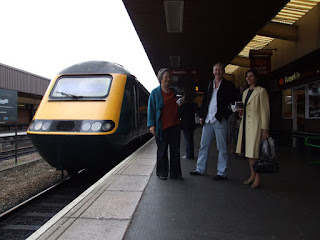
We four from Leicester Writers' Club then walked around being tourists for a couple of hours before catching the train back home. (During which journey, Chris and I reverted to child-like behaviour, competing to be quickest on the draw with mobile phone cameras.)

Monday, May 18, 2009

Society of Authors

I’m off to London today with not one, not two but three wonderful writers and all-round great people. We’re heading for the headquarters of the Society of Authors for the announcement and presentation of the prize for the best writers’ club anthology of the year. Leicester Writers’ Club is in the final shortlist, so it will be very exciting.

The reason the four of us have been chosen to represent the club is that we made up the editorial committee for the anthology. I have to say, the editorial process was not easy but it was always hugely enjoyable.

Another reason for me to be excited about this trip – as if there weren't enough reasons already - is that my great grandfather Aylmer Maude was for some years the treasurer of the Society of Authors, and I am assuming the building we are heading for is the same one that he would have visited many times.

Aylmer Maude

Aylmer had an event-filled life and met many of the influential people of his day. I have several boxes filled with copies of his papers. Among the many highlights are letters from Tolstoy, Gandhi, H.G. Wells, G.B. Shaw, Jane Addams and Dr Marie Stopes. The originals are all kept in the Brotherton Library in Leeds.

When I have time, I'd like to visit the British Library and read more of his correspondence with Marie Stopes. Though I have to say that this might be a problem for me, as I have huge difficulty reading handwriting - a problem not helped by my dyslexia.

Now off to the train, fingers crossed.


Followers